
About Dr. Rewat Bahadur Karki
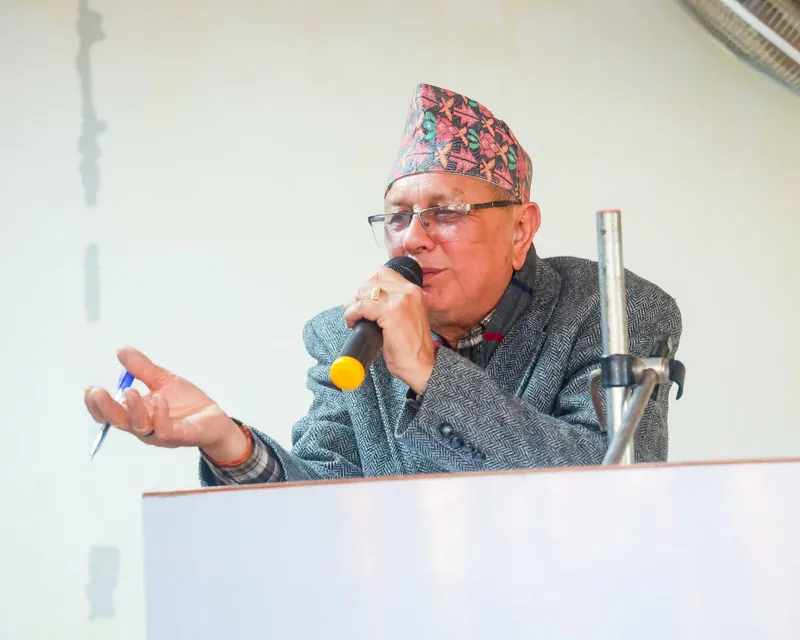
Profile
Four decades in Nepal’s economy
Dr. Rewat Bahadur Karki is a Nepali economist and a banking and capital-market specialist whose career spans four decades, from 1985 to the present. He spent 25 years at Nepal Rastra Bank, rising from Research Assistant in the Research Department to Economic Adviser (first class) and Director of Banking Regulation.
He went on to lead reform of Nepal’s capital market as Chief Executive of Nepal Stock Exchange (NEPSE) and later as Executive Chairman of the Securities Board of Nepal (SEBON). He has also chaired Rastriya Banijya Bank, served as Executive Director of Gramin Bikas Bank and led the Center for Microfinance (CMF), an institution for research and training.
Internationally, he served as an Advisor at the International Monetary Fund in Washington, D.C., overseeing 35 developing and developed countries, and as an Economist at the Bank of Namibia under UNDP.
In July 2025, as Convenor of Nepal Rastra Bank’s Banking Sector Reform Committee (Taskforce), he submitted a detailed report on the structural reform of Nepal’s banking sector, which is now being implemented.
Areas of expertise
- Macroeconomics & monetary policy
- Banking regulation & supervision
- Capital markets & securities regulation
- Banking sector reform
- Microfinance & rural finance
- Economic commentary & writing
Career
From research assistant to regulator
Nepalese dates (BS) are shown as in his CV. Most recent first.
-
July 2025
Chairperson, Banking Sector Reform Committee (Taskforce)
Nepal Rastra Bank
Led the taskforce that produced a detailed report on the structural reform of the banking sector, now being implemented.
-
2018 – 2026
Chairman; Advisor to date
Center for Microfinance (CMF), Nepal
Earlier its Executive Director (2012–2014). CMF is an institution for research and training in microfinance.
-
2072 – 2076 BS
Executive Chairman
Securities Board of Nepal (SEBON)
Led structural reforms of Nepal’s capital market as its regulator.
-
2071/72 BS
Chairman
Rastriya Banijya Bank (RBB)
-
2063 – 2065 BS
Chief Executive Officer
Nepal Stock Exchange (NEPSE)
Contributed to structural reform of the capital market.
-
2062 BS
Director
Confederation of Nepalese Industries (CNI)
-
2002 – 2005
Advisor
International Monetary Fund, Washington, D.C.
Oversaw 35 developing and developed countries.
-
2053 – 2055 BS
Executive Director
Gramin Bikas Bank, Nepal
-
1992 – 1994
Economist
Bank of Namibia (under UNDP), Namibia
-
25 years
Research Assistant → Economic Adviser (first class)
Nepal Rastra Bank
Research Department, and Director of Banking Regulation.
Education & honour
Trained in economics and law
Ph.D. in Economics
Magadh University, Bodh Gaya, India
M.A. in Economics
Tribhuvan University, Nepal
B.A. / B.L.
Tribhuvan University, Nepal
Nepal Vidya Bhushan “A”
Conferred by President Dr. Ram Baran Yadav.
Consultancy & advisory
Short-term consultant and advisor with the World Bank, DFID and other organisations working in the economic sector.
Training & seminars
Participant in more than 50 national and international trainings and seminars, and a resource person at many of them.
Writing
Author of “नेपालको अर्थतन्त्रका आयामहरू” (Dimensions of the Nepali Economy) and numerous articles on the economy, banking and finance.

The book
नेपालको अर्थतन्त्रका आयामहरू
Dimensions of the Nepali Economy
Drawing on 40 years of work in economics, banking, monetary policy, the capital market and the external sector, the book looks at Nepal’s economy through four dimensions: the real sector, public finance, the financial sector (monetary and capital markets) and external trade. It discusses the country’s macroeconomic challenges, the path to double-digit growth and the economic impact of COVID-19, and proposes practical policies for sustainable development.
Former Finance Minister Dr. Ram Sharan Mahat, speaking at the launch, described it as full of information, explanation, analysis and suggestions for anyone interested in economics.
Travel
Seen the world, walked Nepal
Visits across Asia, Europe, Africa and the Americas — and every one of Nepal’s 77 districts.
- Switzerland
- United States
- United Kingdom
- France
- Belgium
- Germany
- Philippines
- Malaysia
- Singapore
- Netherlands
- Austria
- Japan
- Thailand
- Bangladesh
- South Africa
- Namibia
- Hong Kong
- South Korea
- Italy
- China
- Mongolia
- Bhutan
- India
- Sri Lanka
- Pakistan
- Russia
- Canada
- Indonesia
- Qatar
- Armenia
- Spain
- Vietnam
- Maldives
- Turkey
- Cameroon Islands
districts of Nepal visited
From his home village of Mamkha, Okhaldhunga, to every corner of the country.Interviews, talks and advisory work
For a media interview, a seminar or lecture, or advice on banking and capital-market issues, you can reach Dr. Karki directly.
Giving back
Endowments that keep giving
Permanent funds Dr. Karki has set up for banking literature and journalism, school students and people with disabilities.
Samana Banking Award Guthi
An endowment he set up that now stands at about Rs 3.8 million. Every two years it gives the Banking Puraskar (Rs 75,000) for the best book on finance and a Banking Journalism Award (Rs 40,000). It also funds a Rs 15,000 banking scholarship each year for a Tribhuvan University economics student.
Jehandar Scholarship Endowment Fund
A fund of Rs 1.5 lakh at Mamkha Secondary School, Okhaldhunga, that awards scholarships to the school’s best students.
Endowment for people with disabilities
A permanent fund of Rs 2.5 lakh with the NRB Ex-Employees Association to help people with intellectual and physical disabilities.
Social service
Active with Transparency International, the Senior Citizen Federation and various religious institutions.